
For Tampa retailers, product brands, wholesalers, service businesses, and founders launching a store, replacing a restrictive theme, migrating platforms, or removing friction from an existing buying journey.
The right ecommerce platform is the one your business can operate and your customers can trust.
An ecommerce project is not only a homepage and checkout. Product relationships, variants, inventory, search, merchandising, payments, shipping, tax, customer communication, analytics, and the people managing the store all influence which platform and architecture will hold up after launch.
We begin with those operating realities, then choose between Shopify, WooCommerce, or a more custom storefront approach. That keeps platform selection tied to catalog complexity, content ownership, integrations, budget, and growth plans instead of a developer’s default tool.
The public experience receives the same attention. Navigation, collection structure, product information, mobile interaction, accessibility, performance, confidence signals, and cart behavior are designed as one buying path—with practical controls for the team responsible for keeping it current.
Tampa ecommerce planning connects acquisition, fulfillment, and measurement
A Tampa merchant may acquire demand through organic search, social campaigns, local events, partnerships, wholesale relationships, or direct sales. Each source can create a different landing intent and product question. We trace those paths into the catalog, product detail, cart, post-purchase communication, and analytics plan so the site can explain where qualified demand converts or disappears.
Operational decisions receive equal weight. Shipping rules, pickup only when it is genuinely offered, inventory ownership, returns, tax configuration, customer support, promotion logic, product feeds, and reporting are mapped before apps are selected. This keeps the commerce stack accountable to the real fulfillment model instead of forcing the operator to reconcile disconnected systems after launch.
Ecommerce development from platform decision to production launch
Ecommerce strategy and platform selection
Compare Shopify, WooCommerce, and custom approaches against catalog, workflow, integration, ownership, budget, and growth requirements.
Shopify storefront development
Build or improve custom themes, Online Store 2.0 sections, product templates, collections, search, cart states, and merchant controls.
WooCommerce development
Create a structured WordPress commerce experience with purposeful templates, restrained dependencies, and an editing model the team can maintain.
Catalog and product-discovery UX
Organize navigation, collections, filters, search, product information, variants, recommendations, and mobile discovery around how customers shop.
Conversion, accessibility, and performance
Remove avoidable friction, clarify buying decisions, stabilize responsive layouts, optimize media, and test keyboard and mobile journeys.
Migration, integrations, and launch
Plan content and URL migration, connect required services, validate analytics and redirects, and test the complete path to purchase before release.
A complete storefront system is stronger evidence than an isolated mockup.
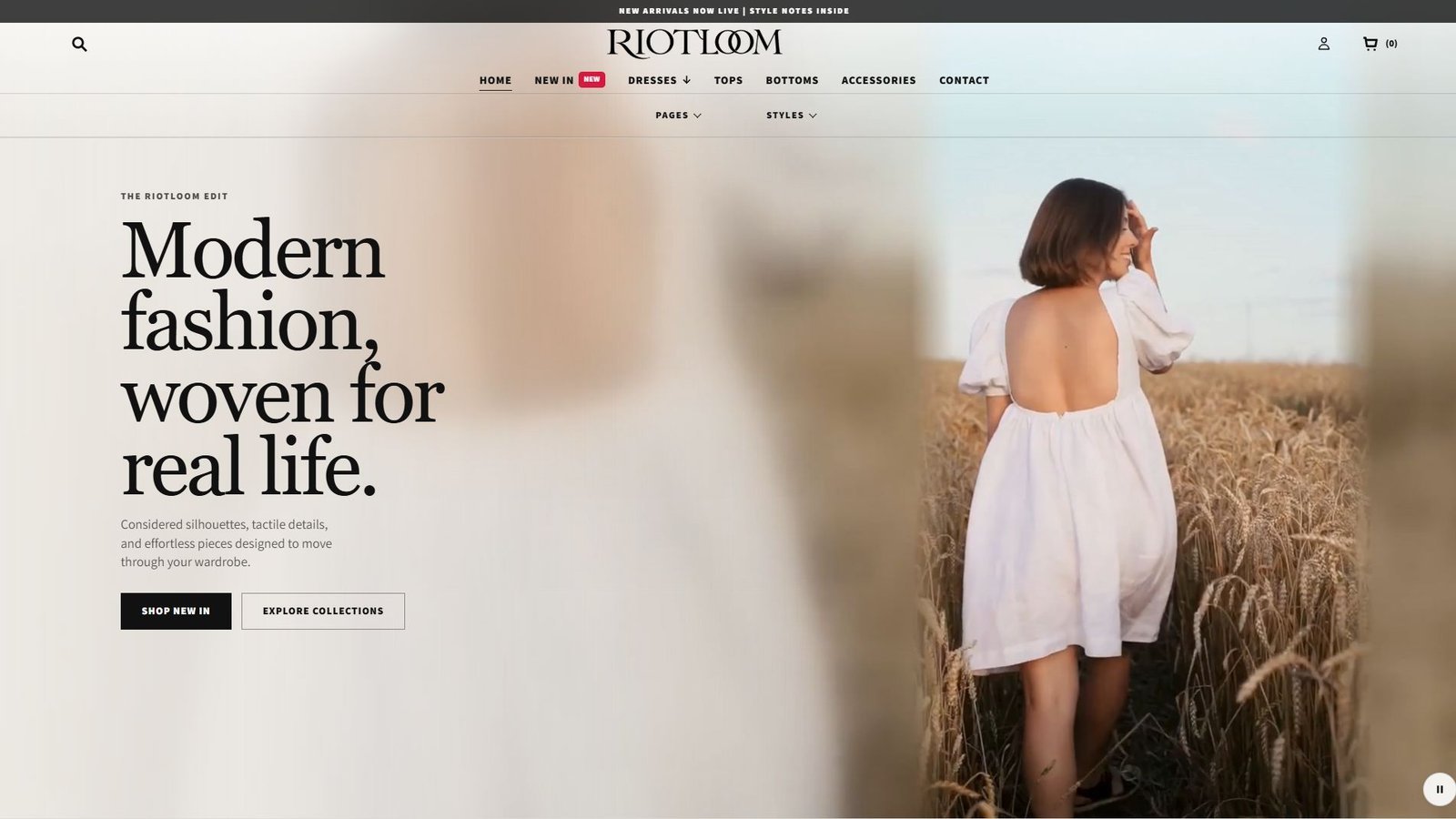
RiotLoom is a fashion-first Shopify Online Store 2.0 theme designed and engineered as a complete ecommerce system. The case study covers editorial merchandising, reusable merchant sections, product and collection templates, predictive search, navigation, cart, customer accounts, and the empty and error states that storefront demos often omit.
Its release validation included 68 desktop and mobile route checks across the storefront. That breadth matters because ecommerce quality is cumulative: a polished product page cannot compensate for confusing discovery, an inaccessible menu, missing variant feedback, or a broken cart state.
RiotLoom is the direct commerce proof. Our application projects add related experience with complex filtering, structured data, responsive interfaces, and static performance—useful when a catalog or customer workflow needs more than a conventional theme can provide.
RiotLoom
Designed and engineered a fashion-first Shopify theme with editorial merchandising, resilient merchant controls, and complete storefront states.
An ecommerce process built around operational risk
- 01 — Audit the business and storeReview products, customers, analytics, catalog structure, content, platform limits, apps, integrations, fulfillment, and conversion friction.
- 02 — Choose the architectureDefine the platform, information model, templates, integrations, migration plan, merchant controls, and success measures.
- 03 — Design the buying systemCreate product discovery, product detail, cart, account, content, and responsive states around realistic catalog data.
- 04 — Build and integrateImplement the storefront, configure content controls, connect approved services, migrate content, and keep dependencies accountable.
- 05 — Validate and launchTest the complete customer journey, analytics, metadata, structured content, redirects, accessibility, performance, and operator workflows.
What businesses ask before starting
What should a complete ecommerce build include beyond the homepage?
Use the storefront checklist to compare product discovery, store states, merchant controls, integrations, performance, and release QA.
Need a site that looks premium and behaves like it was engineered on purpose?
If the current experience feels generic, slow, or unfinished, we can tighten the positioning and ship something that actually earns attention.